

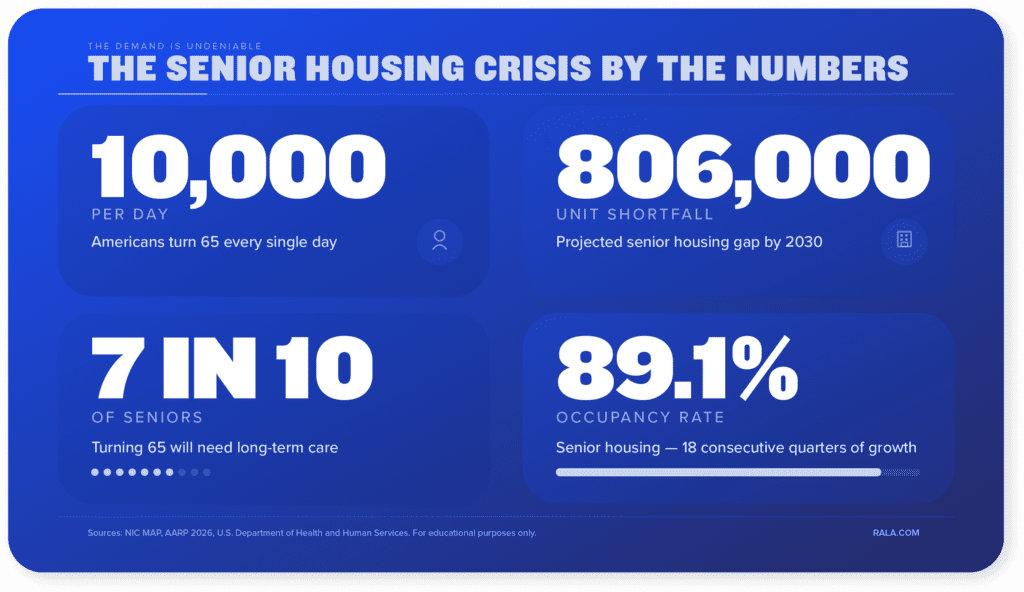
A single residential assisted living home can replace most American household incomes, build a legacy your kids will inherit, and become the place a stranger’s mother spends the best years of her life. With 10,000-11,000 Americans turning 65 every day and a projected shortage of 806,000 senior housing units by 2030 (NIC MAP Vision), there has never been a better moment to do good and do well at the same time.
Residential assisted living (RAL) is a senior care model in which 6 to 16 residents live in a home, not an institution, and receive help with activities of daily living (ADLs) such as bathing, dressing, medication management, and meals. Smaller. More personal. And more profitable per unit than the big-box facilities most people picture when they hear “assisted living.”
Here are 100 reasons to open a residential assisted living home, organized by theme, from the people who’ve helped hundreds of operators launch successful homes across the country.
The Demand Is Undeniable (Reasons 1–12)
The need for senior housing is not a prediction. It is a present reality accelerating every single day.
1. Between 10,000 and 11,000 Americans turn 65 every single day. This figure comes from the ongoing “Peak 65” period, driven by the tail end of the Baby Boomer generation (born 1946–1964). The Silver Tsunami is not coming. It is here.
2. The first Baby Boomers turned 80 in 2026. According to NAIOP and Senior Housing Business, 10,000 Americans now turn 80 every day. This is the cohort with the highest care needs and the greatest willingness to pay for quality help with ADLs.
3. The U.S. faces a massive housing shortage for seniors. With 10,000-11,000 Americans turning 65 every day (LIMRA / Alliance for Lifetime Income) and a projected shortage of 806,000 senior housing units by 2030 (NIC MAP Vision), the demand curve is already past the tipping point. The first Baby Boomers turned 80 in 2026 (NIC MAP) — the cohort with the highest care needs and the greatest willingness to pay for quality help with ADLs.
4. 7 in 10 people turning 65 today will need long-term care in their lifetime (HHS / Administration for Community Living). Not some. Not a few. Seven out of ten.
5. Senior housing occupancy has climbed for 18 consecutive quarters, reaching 89.1% by the end of 2025 (NIC). Beds are filling faster than they are being built.
6. By 2030, every Baby Boomer will be 65 or older, making up roughly 20% of the U.S. population (U.S. Census Bureau). By 2034, people 65 and older will outnumber children under 18 for the first time in American history (U.S. Census Bureau).
7. 6.9 to 7 million Americans currently live with Alzheimer’s disease (Alzheimer’s Association), projected to reach 13.8 million by 2060. By age 85, roughly 1 in 3 seniors has Alzheimer’s dementia.
8. Memory care demand is surging, and small homes are uniquely positioned to serve it. Big-box memory care wings feel institutional. A 10-bed home where staff know every resident’s name, routine, and triggers? That is what families are searching for.
9. The “forgotten middle” is underserved. New senior housing construction targets upper-income residents almost exclusively, leaving middle-income seniors with few quality options. A 2024 NORC update to its landmark “Forgotten Middle” research projects that by 2033, there will be 16 million middle-income seniors aged 75 and older, and nearly 40% will be unable to afford assisted living even after tapping home equity (NORC at the University of Chicago). RAL homes fill that gap.
10. Solo agers and shrinking family networks are redefining who needs care. Seniors with no spouse or adult children have no caregiver safety net. They need quality care homes more than anyone. And the problem is growing: there are fewer adult children available per aging parent than at any point in recent history (AARP), meaning even seniors with families face thinner support networks than previous generations did.
11. The caregiver-to-senior ratio is collapsing. In 2010, there were roughly 7 potential family caregivers for every person 80 and older. By 2030, that number drops to 4, and by 2050 it falls to fewer than 3 (AARP Public Policy Institute). Every year, the math pushes more families toward professional care. RAL homes are where those families land.
12. The 85+ population is the fastest-growing demographic in the United States (U.S. Census Bureau). The people who need the most care, stay the longest, and are most willing to pay for quality are multiplying faster than any other group.
The Financial Case (Reasons 13–30)
This is where the numbers make the case. RAL is not just a good business. It is a fundamentally different financial model from traditional real estate investing.
13. A single RAL home can generate $10,000+ in net monthly cash flow. With 10 residents each paying $4,000 to $6,000 per month, gross revenue reaches $40,000 to $60,000. After operating expenses, operators report $5,000 to $15,000 in monthly net cash flow depending on market, home size, resident mix, and level of care. Compare that to the roughly $500-per-month average for a traditional single-family rental.
14. The revenue is not just the base rate. This is what most people miss. Base room and board often accounts for only 50% to 75% of what a resident actually pays. The rest comes from care tiers, medication management (around $300 per month), incontinence care ($200 to $500+ per month), transportation, and other services. A $4,000 “base rate” resident often pays $5,000 to $7,000 total. The revenue stack is layered, not one-dimensional.

15. Memory care commands roughly a 20% premium over standard assisted living. The average memory care rate reached $7,645 per month in 2026 (U.S. News). A 6-bed to 10-bed memory care home can generate significantly higher revenue per resident than a standard care home.
16. RAL is recession-resistant. According to the National Investment Center for Seniors Housing & Care, senior housing was the only commercial real estate asset class to experience positive asking rent growth during the Great Recession, outperforming every other property type on rent growth and investment returns (NIC). When a senior needs care, the decision is driven by health, not the Dow Jones.
17. Private-pay insulates you from government reimbursement risk. Unlike nursing homes dependent on Medicare and Medicaid, RAL homes primarily serve families paying directly for quality. No billing codes. No reimbursement delays.
18. Inflation is a tailwind, not a headwind. Genworth cited inflation as the number one driver of assisted living price increases in 2024, with rates rising 10% year over year (Genworth and CareScout 2024 Cost of Care Survey). Between 2021 and 2023, assisted living costs rose 18.9% (Senior Housing News). RAL operators pass these increases through.
19. You own two assets in one: real estate and a cash-flow business. The property appreciates over time, while the business generates recurring monthly income. On exit, each is valued separately. The business can be valued at 2 to 5 times annual EBITDA, per Isabelle Guarino, CEO of Residential Assisted Living Academy, based on her experience with RAL transactions.
20. Multiple exit strategies. Sell the business, sell the real estate, sell both together, or convert to another form of Group or Shared Housing. Few investments give you this many ways out.
21. Cash-on-cash returns of 8 to 25%. Senior housing operating margins surpassed 25% in mid-2025, the highest since 2018, as occupancy and rent growth outpaced expense inflation (NIC MAP). Smaller RAL homes with dialed-in operations have the potential to reach similar territory.
22. Tax advantages most investors don’t know about. Real estate depreciation, cost segregation (which accelerates depreciation on short-life assets like fixtures, appliances, and flooring), business expense deductions, and 1031 exchange eligibility. These are not footnotes. They are powerful wealth-building tools.
23. One stabilized RAL home can replace most W-2 incomes. The U.S. median household income in 2024 was $83,730 (U.S. Census Bureau), roughly $5,200 per month after taxes. One home generating $5,000 to $10,000 per month in net cash flow covers that. Three homes at $10,000 per month average put you at $360,000 per year, well within the top 5% of U.S. household income.

24. Boomer wealth is enormous: $71+ trillion combined. The generation needing care can afford it. This is not a market worried about whether families can pay.
25. Long-term care insurance can cover a significant portion of monthly costs for residents with policies, creating a secure revenue stream with less family financial stress.
26. VA Aid and Attendance benefits create a dedicated funding source. Nearly half of all U.S. veterans are 65 or older. This tax-free monthly benefit helps qualified veterans pay for assisted living.
27. Higher revenue per square foot than any standard residential use. A home collecting $500 per month as a rental can produce $30,000 to $70,000+ per month in gross revenue as a stabilized RAL operation.
28. Predictable, recurring monthly income. The average assisted living length of stay is 22 months. Your residents are long-term, and revenue is contractual and consistent, not seasonal or speculative.
29. You don’t compete on price. The families choosing a home for Mom aren’t shopping for the cheapest option. They’re shopping for the one they can sleep at night about. Quality commands premium pricing.
30. Assisted living costs are rising faster than inflation, and the 2025 national median reached $6,200 per month (CareScout 2025 Cost of Care Survey). Your revenue grows even when you don’t add a single bed.

The Business Model Advantages (Reasons 31–50)
RAL is not just profitable. It has structural advantages that most businesses and investments simply cannot match.
31. You inherit a referral ecosystem you don’t have to build. Placement agencies, hospital discharge planners, geriatric care managers, physicians, elder law attorneys, and Veterans Service Organizations all actively refer families to care homes. You don’t have to outspend big-box facilities on marketing. You build relationships with the people already looking for homes like yours.
32. Hospital discharge planners need you. The federal Hospital Readmissions Reduction Program penalizes hospitals up to 3% of their entire inpatient Medicare reimbursement for excess 30-day readmissions. Hospitals have multi-million-dollar incentives to refer patients to places where they recover well. That is your home.
33. Geriatric care managers actively prefer small homes for complex situations: difficult behaviors, advanced dementia, and socially fragile residents. Because families pay these professionals directly ($75 to $250 per hour), their recommendations carry serious weight. And they point to homes like yours.
34. Federal law generally protects RAL homes that serve residents with disabilities. Under the Fair Housing Act (1988 amendments) and the Supreme Court’s ruling in City of Edmonds v. Oxford House, Inc. (1995) (U.S. Supreme Court), municipal zoning rules that restrict group homes are subject to federal review. For homes serving seniors with dementia, mobility impairments, or other qualifying conditions, that protection typically applies in residential zones. You are not finding a loophole. You are operating under nearly four decades of established civil rights law.
This is general information, not legal advice. Confirm your specific situation with a qualified attorney familiar with FHA and your local zoning rules before relying on it.
35. Forced appreciation rewards your effort. A $500,000 home generating $3,000 per month as a rental looks very different when it is producing $80,000 in annual NOI as a stabilized RAL. Using the income approach at a 9% cap rate, that same property can appraise at roughly $890,000. The value increase is not market luck. It is the operator’s reward for doing the conversion, licensing, and stabilization work.
36. You can scale from one home to many. Many RAL operators start with a single home and scale to three, five, or ten, building systems that allow each additional property to run with less owner involvement.
37. Lower startup costs than large facilities. A 100-bed facility may cost $10 million to $50 million. An RAL home needs a single-family property plus $55,000 to $500,000 in equipment, renovation, and working capital.
38. Creative financing makes entry accessible. SBA 7(a) loans, SBA 504 loans, seller financing, partnerships, and private lending are all proven paths. Under current SBA guidelines, experienced operators with one profitable home may qualify for reduced equity injection, and in some cases, 0% down on additional same-NAICS facilities.
39. Niche markets let you specialize and command premium pricing. Memory care homes, veterans-focused homes, faith-based homes, couples care, cultural and language-specific homes, and hospice-friendly environments. Each niche reduces competition and increases your value.
40. Lower vacancy risk than almost any other real estate class. With assisted living occupancy at 87.7% industry-wide and climbing, beds are in demand. Well-run homes maintain waitlists.
41. No franchise fees or corporate royalties. You build your own brand, set your own standards, and keep what you earn.
42. You can use existing single-family homes. No commercial construction required. Convert a home that already exists in a residential neighborhood.
43. Barriers to entry protect existing operators. State licensing (60-day to 120-day applications), operational know-how, and local relationship-building take real time and effort. These are learnable, one-time barriers that protect you from speculative competition once established.
44. Private rooms versus companion suites give you pricing flexibility. A 350 square foot studio rents for around $4,500 per month as a private room, but the same space produces roughly $6,600 when shared as a companion suite (around $3,300 per person). You can position all-private (premium), companion-suite (higher total revenue from the same square footage), or hybrid. That is strategic flexibility big-box facilities rarely have.
45. Transparent pricing is a real competitive advantage. AARP’s June 2025 investigation called out hidden fees across the assisted living industry, documenting how families face unexpected charges tied to opaque tiered pricing systems (AARP). Families are wary. RAL homes that offer upfront, all-inclusive pricing earn trust faster. In the 2026 trust environment, transparency is not just good ethics. It is good business. This is a positioning opportunity most operators have not caught up to yet.
46. Word-of-mouth is the number one referral source for senior living, according to NIC. At RAL scale, satisfied families become concentrated, powerful advocates. One happy family tells their friends, their church, their hairdresser, and their neighbor.
47. Faster decision-making as a small business owner. No corporate approvals. No board meetings. You see something that needs to change, you change it. That speed is a competitive advantage big-box operators cannot match.
48. Multi-home portfolios attract institutional buyers on exit. A three-home portfolio with documented cash flow, stable occupancy, and trained staff is exactly what investors and operators are looking to acquire.
49. Residential property values are more stable than commercial. Your underlying real estate maintains value even through commercial real estate downturns.
50. Multiple revenue streams from a single property. Base rent, care tiers, medication management, transportation, move-in fees, and second-occupancy charges. You are not dependent on one rent check from one tenant.
The Impact You’ll Make (Reasons 51–65)
This is the “Do Good” half of the equation. The care quality difference between a small RAL home and a big-box facility is not marginal. It is night and day.

51. Caregiver-to-resident ratios tell the whole story. RAL homes typically maintain 1 caregiver for every 5 residents. Big-box facilities run 1 to 15 or even 1 to 30. That single comparison captures why care is fundamentally different in a smaller setting.
52. 59 million Americans are unpaid family caregivers, providing 49.5 billion hours of care annually, valued at $1.01 trillion (AARP, Valuing the Invaluable 2026). Every RAL home you open directly relieves this burden. Every family you serve gets to be a family again instead of an exhausted caregiving team.
53. 61% of family caregivers are also working, and nearly 70% report difficulty balancing career and care. You are solving one of the most painful, widespread problems in American family life.

54. Residents become family, not room numbers. With 6 to 16 people sharing a real home, relationships form naturally. Staff know every resident by name, by preference, by story.
55. Better caregiver retention. Big-box assisted living facilities had 42.1% staff turnover in 2022, with frontline personal care positions running as high as 49% (McKnight’s Senior Living). Smaller homes retain caregivers longer because the work is less burnout-inducing and more personally meaningful. When your caregivers stay, your residents thrive.
56. Couples can stay together. Large facilities frequently separate spouses across acuity levels. RAL homes can keep couples in the same home, sometimes in the same room. For families, that alone is worth everything.
57. Real living rooms, family-style dining, backyard gardens. Seniors live in an actual home, not a hallway with numbered doors. The environment itself contributes to dignity, comfort, and quality of life.
58. Home-cooked meals around a shared table. Activities tailored to a handful of residents instead of a generic calendar for 200. Better food. Better care. Better experience. Across the board.
59. The difference between RAL and big-box isn’t marketing. It’s physical. Where big-box facilities feel like hotels at best and hospitals at worst, RAL homes feel like home. That is not a tagline. It is the literal, built reality of what you create.
60. Longer length of stay when care is good. Industry average is 22 months. Well-run homes with consistent, personalized care often see significantly longer stays. Better care means better outcomes and longer revenue per resident.
61. Lower exposure to mass-infection events. COVID-19 disproportionately devastated large institutional facilities. Smaller homes with fewer residents and more stable staff proved safer.
62. You control your own care standards. No corporate mandates. No cutting corners to hit earnings targets. You set the quality bar for your home.
63. You serve the adult child as much as the senior. The person choosing a home is typically a 50 to 70-year-old daughter looking for peace of mind for her parent. You are answering the question that keeps her up at night: “Will Mom be okay?”
64. You keep seniors in their community. RAL homes are in neighborhoods, not industrial parks. Residents stay connected to the places and people they have known for decades.
65. You can heal your own caregiving story. Many operators enter this business after a difficult experience placing their own parents. Gene Guarino, founder of RALA, opened his first home to care for his mother. Building a quality home is personal. It was personal from the beginning.
The Lifestyle and Freedom (Reasons 66–80)
RAL is not just a good investment. It is a vehicle for building the life you actually want.
66. You are a CEO, not a caregiver. The number one objection people have is “I don’t want to change bedpans.” You will not be doing that. You hire compassionate, trained caregivers and a manager to handle day-to-day care. McDonald’s owners don’t flip burgers.
67. No medical background required. You are building a business. The care professionals you hire bring the clinical expertise.
68. With the right systems and staff, RAL can run in as few as a few hours per week of owner involvement. Some operators manage homes from different states entirely. This is not a day-one reality. It is what the business becomes after stabilization.
69. You can run it alongside another career initially. Many operators keep their W-2 while launching their first home, then transition once cash flow is proven.
70. Ideal second-career business. RAL is particularly well-suited for professionals in their 40s to 60s: attorneys, teachers, military retirees, and corporate professionals who want meaningful, profitable work for the next chapter.
71. Family-business friendly. Spouses, adult children, and extended family can all participate. Many operators build RAL as a multigenerational operation.
72. Build generational wealth. Real estate appreciates. The business produces recurring cash flow. Together, they create a legacy asset you can pass to your children.
73. Purpose-driven work every single day. You are not selling widgets. You are providing a home for someone’s parent. That matters at midnight when you’re solving a staffing problem, and when a resident’s daughter hugs you in the hallway.
74. You can start with one home and prove the model before scaling. No need to bet everything on day one. Open one, stabilize it, learn the business, then grow.
75. No inventory, no shipping, no platform risk. Unlike e-commerce or Airbnb, your business is not dependent on algorithms, supply chains, or seasonal demand.
76. Not subject to short-term rental bans. While cities crack down on Airbnb and vacation rentals, RAL homes are protected by the federal Fair Housing law.
77. Less competitive than multifamily real estate investing. Far fewer people know about RAL than know about apartment syndication or fix-and-flips. That is your advantage.
78. You can build the business in your own community, serving people you already know. Most RAL operators open their first home within an hour of where they live. Your neighbors, your church community, your professional network: these become both your first referral sources and the families you serve. Few businesses let you build wealth while staying rooted exactly where you are.
79. It rewards people who can see the people behind the spreadsheet. If you are the kind of person who notices that a resident always takes her toast with extra butter, you will run a home that families never want to leave. And you will build wealth doing it.
80. Financial freedom is not a slogan here. It is math. One home at $10,000 per month net replaces most incomes. Two homes give you breathing room. Three homes change your family’s trajectory permanently.
The Support System Exists (Reasons 81–92)
One of the best reasons to open a residential assisted living home right now is that you are not figuring it out alone. A proven system already exists.
81. Residential Assisted Living Academy (RALA) provides a step-by-step training system, including the 3-Day Fast Track live training, coaching from operators who currently own and run RAL homes, and access to a 30,000+ member national association (RALNA). This is not a theory. It is a framework tested across hundreds of homes nationwide with success stories dating as early as 2015.
82. RALA coaches are current and former operators, not retired teachers. They own and run homes right now or have successfully built one or more RAL businesses. They are implementing the model they teach in real markets, with real residents and real problems.
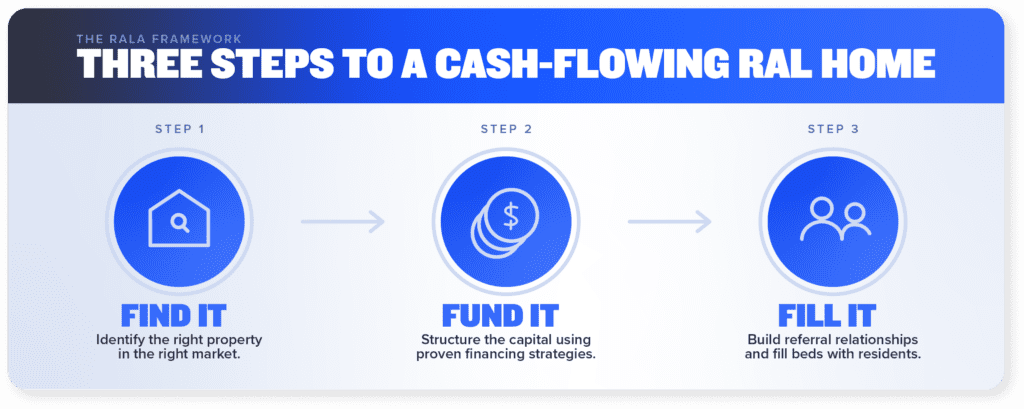
83. The “Find it, Fund it, Fill it” framework gives you a clear, named system for opening your first home: find the right property, fund it with the right capital structure, and fill it with residents through proven referral and marketing strategies.
84. A proven roadmap saves years of trial and error. Learning from someone who has done it once is helpful. Learning from people who have done it across hundreds of homes is a different category entirely.
85. RALNA (Residential Assisted Living National Association) connects you with 30,000+ members nationwide, providing networking, a RAL Home Locator tool, resource libraries, and community support.
86. Avoid the costliest mistakes. Licensing errors, wrong property choices, bad staffing decisions, and underpricing care. These are expensive lessons that can cost $50,000 or more. A proven system helps you skip them.
87. You learn from people who understand both sides. As Isabelle Guarino puts it: “This is a people industry, not a money one, not a real estate one. Although both are involved.” RALA’s framework is built on doing good and doing well. Not just one or the other.
88. Gene Guarino, founder of RALA, built the training framework from direct operational experience, starting with a home to care for his own mother. The model was born from a personal mission, not market speculation.
89. Specialty training like Growing with Memory Care gives you a clear path to the highest-revenue niche in the industry.
90. The Impact Builder app walks you step-by-step through opening your first home, turning an overwhelming process into a manageable sequence.
91. You join a community of operators who share what works. Mastermind groups, annual events, and peer networks mean you always have someone to call when something comes up that you have not seen before.
92. The path from curiosity to confidence is documented. Hundreds of RALA students have opened homes across the country, many operating multiple homes, some doing it hands-off from another state.
The Timing Is Now (Reasons 93–100)
Every reason above has been building for years. What makes right now different is the convergence of all of them at once.
93. Federal policy is shifting in your favor. In 1988, just 12% of Medicaid long-term care spending went to home and community-based services. By 2020, that number had climbed to 63% (CMS Medicaid LTSS Expenditures Report). The entire federal apparatus, through the ADA, the Olmstead Supreme Court decision, and the Affordable Care Act, is committed to moving care out of institutions and into community settings. RAL is the small-business expression of that policy direction.
94. The hospital readmission penalty creates structural demand for your home. Since 2012, hospitals have faced penalties of up to 3% of their base Medicare inpatient payments for excess 30-day readmissions (CMS). This is a federal policy tailwind that pushes hospitals to refer to settings where patients get great care. That is what you are building.
95. Construction is not keeping pace. With the current building meeting only 25% of the needed supply, every month that passes widens the gap between available beds and seniors who need them.
96. First-mover advantages exist in local markets. In many communities, there are zero or very few quality RAL homes. The operator who opens first, builds referral relationships, and earns a reputation becomes the default choice for every family, physician, and discharge planner in the area.

97. The 85+ population is accelerating. The people who need the most care, stay the longest, and are most willing to pay are the fastest-growing group in the country. This trend does not reverse for decades.
98. Dementia care costs are projected to reach nearly $1 trillion annually by 2050 (Alzheimer’s Association). The operators positioned now will serve that demand for the rest of their careers.
99. Proven success stories exist across the country. This is not a new, untested concept. Hundreds of operators have already done it, documented it, and shared the playbook.
100. The opportunity to do good and do well does not come along often. Most businesses ask you to choose between making money and making a difference. RAL lets you do both. The demand is real. The model is proven. The question is whether you will be one of the people who step into it.
Frequently Asked Questions
No. You are the business owner, not the caregiver. You hire trained, compassionate care staff to provide day-to-day support to residents. Your role is to build and manage the operation.
Beyond the real estate, expect $55,000 to $500,000 in equipment, renovation, licensing, and working capital, depending on home size and market. See the full cost breakdown here.
Operators report $5,000 to $15,000+ in net monthly cash flow per home, depending on market, home size, resident mix, and level of care offered.
Senior housing has demonstrated unusual stability through downturns. NIC documents that it was the only commercial real estate asset class with positive asking rent growth during the Great Recession (NIC). Care decisions are driven by health needs rather than economic conditions, which is why senior housing REITs reported rent collection rates above 95% from their operating tenants throughout the COVID downturn, even as occupancy came under significant pressure.
Yes. With the right systems and a trained manager and care staff in place, many operators manage homes from other cities or even other states.
Typically, 6 to 16 residents, depending on the property and state licensing. This small scale is what allows for personalized care and a genuine home environment, and it is what sets RAL apart from big-box facilities.
What’s Your Next Step?
If these 100 reasons resonate, the best next step is to see the full model up close. RALA’s 3-Day Fast Track is a live training in Phoenix, Arizona, that takes you from curiosity to a working business plan, including facility tours, expert panels, and direct access to operators who are doing this right now. It is where hundreds of successful RAL operators got their start.
The demand is real. The formula is proven. Hundreds of RALA students have already done what these 100 reasons describe. The only question left is whether the next one is you.